Anthony Benezet (1713-1784)
Biography
Anthony Benezet was born in St. Quentin, northern France, on 31 January 1713. His family were Huguenots - French Protestants - who had been suffering increasing persecution since the revocation of the Edict of Nantes in 1685. In 1715, when Benezet was two years old, they emigrated to London, where he received an education suitable for the son of a properous family of merchants.London proved to be a temporary home. In 1731, when Benezet was seventeen years of age, the family emigrated once more, this time to Philadelphia in the British American colony of Pennsylvania. Here Benezet joined the Society of Friends, or Quakers. His early attempts at a career in trade were unsuccessful and, in 1739, he started as schoolteacher at Germantown. Three years later, he moved to a position at the famous Friends' English School of Philadelphia (now the William Penn Charter School) where he was noted both for being a fine teacher, and for his dislike of the severe discipline then common. In 1750, in addition to his day duties, he set up an evening class for enslaved children which he ran from his own home. In 1754, he left the Friends' English School to set up one of his own exclusively for girls - the first public girls' school in America. He was dogged by ill health, however, and was not able to maintain an uninterrupted career. Nevertheless, he continued to teach enslaved children from his own home until 1770 when, with the support of the Society of Friends, he set up the Negro School at Philadelphia. He subsequently taught at both of these school almost until his death.
From at least the 1750s, Benezet became a firm opponent of slavery. Working alongside John Woolman, he participated in the debates taking place in Quaker circles at that time over whether Friends should be allowed to buy and sell slaves. Although this debate had been taking place since the late seventeenth century, it had not resulted in any firm action. Benezet and Woolman were, by 1758, able to convince Quakers in Pennsylvania and New Jersey that slave trading was not consistent with Christian doctrine and that Quakers in those colonies should be asked to stop. Within three years, the London Yearly Meeting had issued a 'strong minute' asking Quakers everywhere to stop their participation in the slave trade.
Benezet continued his antislavery efforts by taking the message to a wider community. He wrote and published at his own expense a number of antislavery tracts and pamphlets. Of these, Some Historical Account of Guinea, published in October 1771, was by far the most influential on both sides of the Atlantic. The pamphlet was read and, to a certain extent, imitated by both Granville Sharp and John Wesley, both of whom corresponded with Benezet and distributed his works in England. Several years later, Benezet's works were instrumental in persuading Thomas Clarkson to embark on his abolitionist career, and Benezet's Some Historical Account of Guinea was reprinted several times during the height of the abolition campaign. Benezet, however, did not live to see antislavery become a powerful force, either in Britain or America. He died on 3 May 1784, and is buried in the Friends' Burial Ground, Philadelphia. Benezet perhaps qualifies more as an American than a British Abolitionist, but his influence on the British abolition campaign cannot be doubted.
© Brycchan Carey 2002
Bibliography
Selected Works
- Observations on the inslaving, importing and purchasing of Negroes. With some advice thereon, extracted from the Epistle of the yearly-meeting of the people called Quakers held at London in the year 1748. 2nd edn (Germantown, 1760)
- A short account of that part of Africa inhabited by the negroes. (Philadelphia: W. Dunlap, 1762)
- A Caution and Warning to Great Britain and her Colonies, in a short representation of the calamitous state of the enslaved negroes in the British Dominions. Collected from various authors, etc. (Philadelphia: D. Hall & W. Sellers, 1767)
- Some Historical Account of Guinea ... With an inquiry into the rise and progress of the slave-trade ... Also a republication of the sentiments of several authors of note on this interesting subject; particularly an extract of a treatise by Granville Sharp (Philadelphia: Joseph Crukshank, 1771)
Modern Editions
- Benezet, Anthony, Some Historical Account of Guinea ... A new impression of the edition of 1788, etc (London: Frank Cass & Co., 1968)
- Crosby, David L., ed., The Complete Antislavery Writings of Anthony Benezet, 1754-1783: An Annotated Critical Edition (Baton Rouge: Louisiana State University Press, 2013). | Available from: Amazon.com (USA) | Amazon.co.uk (UK and Ireland) |
- Kitson, Peter, et al, eds, Slavery, Abolition and Emancipation: Writings in the British Romantic Period (London: Pickering and Chatto, 1999), 8 vols.
Secondary Works: Biography and Special Studies
- Armistead, Wilson, Anthony Benezet. From the original memoir [by Roberts Vaux]: revised, with additions (London: A. W. Bennett, 1859)
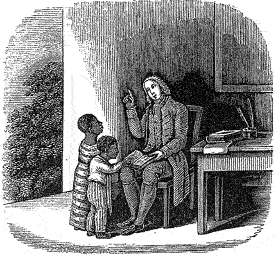
- Barber, John Warner, and Elizabeth Gertrude Warner, Historical, Poetical and Pictorial American Scenes; principally moral and religious; being a selection of interesting incidents in American history; to which is added a historical sketch, of each of the United States, (New Haven: J.H. Bradley, 1851). Includes the image of "Benezet instructing colored children", seen on this page.
- Brookes, George S., Friend Anthony Benezet (Philadelphia: University of Pennsylvania Press, 1937). A collection of Benezet's letters and minor writings, preceded by an account of his life.
- Carey, Brycchan, 'Anthony Benezet, Antislavery Rhetoric and the Age of Sensibility', Quaker Studies, 21:2 (2016): 7–24. Discusses Benezet in the context of the eighteenth-century cult of sensibility.
- Carey, Brycchan, From Peace to Freedom: Quaker Rhetoric and the Birth of American Antislavery, 1657-1761 (New Haven: Yale University Press, 2012). Discusses Benezet in the context of the long Quaker debate about slavery. | Find Out More |
- Jackson, Maurice, Let This Voice Be Heard: Anthony Benezet, Father of Atlantic Abolitionism (Philadelphia: University of Pennsylvania Press, 2010). A very fine recent biography of Benezet. | Available from: Amazon.com (USA) | Amazon.co.uk (UK and Ireland) |
- Sassi, Jonathan D., "Africans in the Quaker image: Anthony Benezet, African travel narratives, and revolutionary-era antislavery", Journal of Early Modern History 10 (May 2006): 95-130. DOI: 10.1163/157006506777525511. Important textual analysis of Benezet's sources and major themes.
- Vaux, Roberts, Memoirs of the life of A. Benezet (Philadelphia, 1817)
Links
- Anthony Benezet, Father of Atlantic Abolitionism
A film about Benezet from the Library of Congress featuring Maurice Jackson - Anthony Benezet Letters
Catalogue of the Benezet papers at Haverford College, Pennsylvania, with biography and images.